AI narration · about 5 min
Can you Block, Private Flock?
Private Flock Cameras Are Already in Pinellas — So What Can You Actually Do About Them?
Florida’s fight over Flock cameras has mostly focused on government surveillance. But there’s another piece of this story that’s much easier to miss:
You can remove a Flock camera from a state road. That doesn’t mean the cameras disappear.
Private businesses can operate automated license plate readers in their parking lots — and two of the biggest retailers in America, Home Depot and Lowe’s, openly acknowledge using ALPR technology.
And this isn’t just something happening somewhere else.
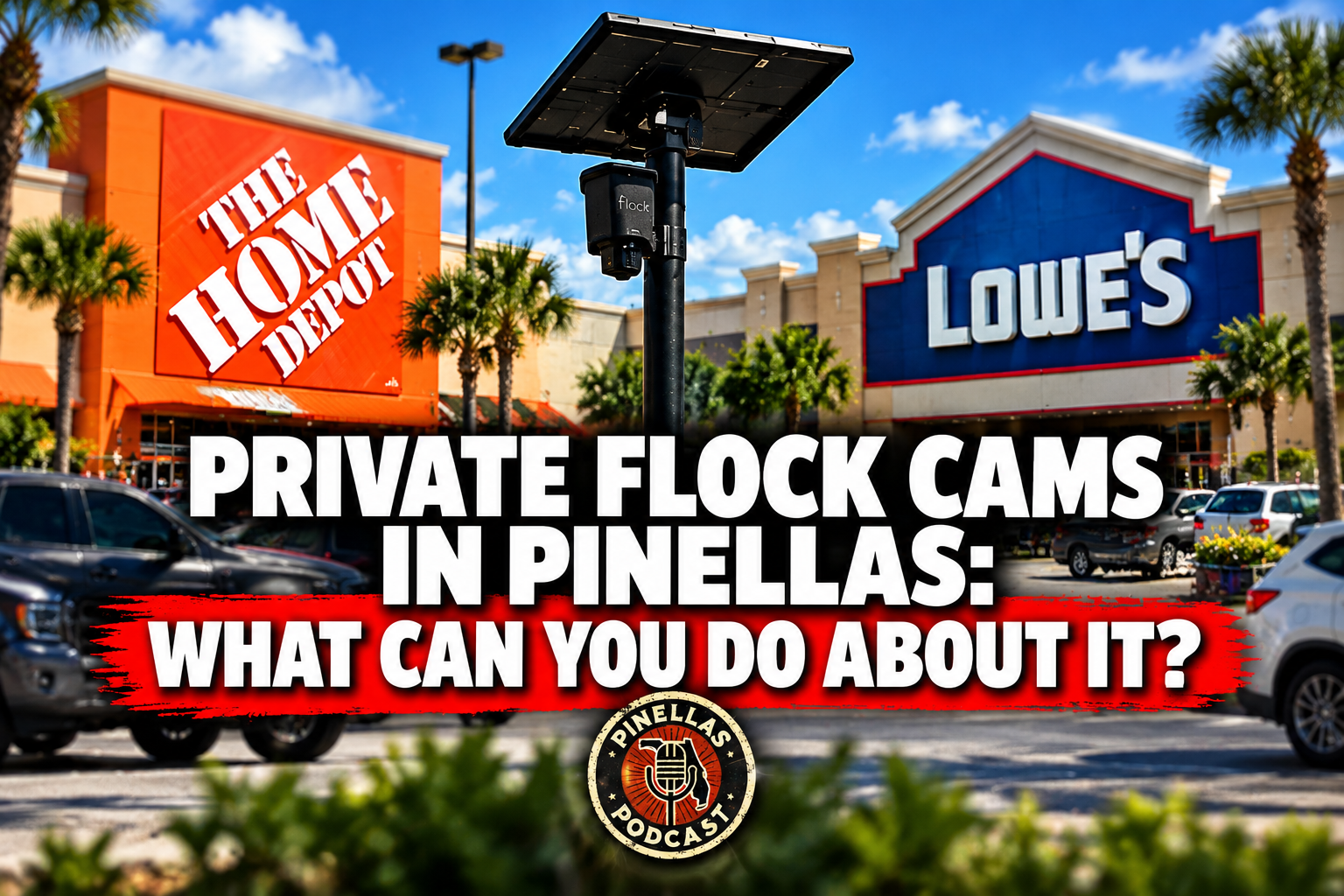
The Tampa Bay Times recently photographed a Flock camera monitoring vehicles entering a Home Depot parking lot in Pinellas Park. The newspaper also reported that law enforcement can potentially access privately operated cameras when the business allows it.
So while Florida has been pushing Flock cameras off state highway rights-of-way, you could still encounter one while heading into a store to buy a hammer.
Home Depot: Yep, They’re Reading Plates
Home Depot says it uses automated license plate recognition systems in select parking lots.
According to the company, the systems are used to prevent and investigate theft, fraud and organized retail crime and to help protect customers and employees.
Home Depot says the technology does not use facial recognition or biometrics.
The company also says access to its ALPR system is limited to authorized local and in-state law enforcement agencies. Home Depot says it does not provide federal agencies or immigration enforcement access to its ALPR system or database.
That’s an important distinction.
This isn't necessarily a camera automatically feeding every government agency in America. The private business operating the system can have control over who gets access.
Lowe’s Is Reading Plates Too
Lowe’s is also surprisingly direct about this in its privacy policy.
At some stores, Lowe’s says cameras around parking areas automatically capture vehicle and license plate images along with the date, time and general location.
The company says the technology can be used for security, theft and fraud prevention, parking enforcement and safety.
Lowe’s says trained asset-protection employees, information-security personnel and certain service providers may access the information. The company can also disclose information in response to state or local law-enforcement requests or valid legal process.
Lowe’s says it generally retains ALPR information for no more than 90 days, although there are exceptions for investigations, legal obligations and states requiring shorter retention periods.
Here’s Where Florida Gets Interesting
Florida recently made a major move involving these cameras on state highway rights-of-way.
The Florida Department of Transportation moved to remove local law-enforcement license plate readers from state highway rights-of-way amid the larger debate over surveillance, privacy and how these systems are being used.
But here's the important part:
That does NOT mean Florida banned license plate readers.
Florida law recognizes automated license plate recognition systems, and privately operated cameras present a very different situation from a police department putting a camera alongside a state highway.
In other words:
Public road ≠ private parking lot.
And that's why removing government-operated cameras from certain roads doesn't necessarily change what happens when you pull into private property.
So Can You Tell Home Depot Not to Scan Your Plate?
Here's the part some people aren't going to love.
There doesn't appear to be a simple Florida opt-out that allows you to drive into a retailer's parking lot, tell its ALPR camera not to capture your plate, and continue shopping.
Your license plate is displayed on the outside of your vehicle, and you're voluntarily driving onto property that's open to customers.
Florida's ALPR statute does not appear to create an individual opt-out mechanism that prevents a private retailer's camera from capturing your plate as you enter.
That doesn't mean a business can necessarily do anything it wants with the information. Privacy policies, retention requirements, data-access rules and other laws still matter.
But if your position is:
“I absolutely don't want that company recording my license plate.”
Your most effective option may also be the simplest:
Don't drive onto the property.
Yep. That's pretty much where we are.
And This Is WAY Bigger Than Home Depot and Lowe’s
A recent Business Insider investigation looked at growing scrutiny surrounding Flock cameras at major retailers, including Home Depot and Lowe’s.
Flock told the publication it has more than 5,000 private-sector customers, ranging from retailers and healthcare organizations to small businesses and places of worship.
That's where this story becomes much bigger than a camera sitting outside a hardware store.
For the past few years, much of the Flock debate has sounded like:
Police + cameras + public roads.
But the modern network can also involve:
Private businesses + private property + license plate databases + businesses deciding who gets access.
Supporters argue these systems can help retailers combat organized theft, identify suspect vehicles and provide valuable evidence to investigators.
Privacy advocates see something very different: a growing network capable of creating searchable records of where ordinary vehicles have been — even though the overwhelming majority of those drivers aren't suspected of committing a crime.
And Florida is now right in the middle of that debate.
So here’s the Pinellas question...
If a camera helps catch someone stealing thousands of dollars of merchandise, are you okay with your plate being captured too?
And if you're not?
What are you actually going to do about it — stop shopping there?
Because apparently Florida's Flock controversy didn't end when cameras started coming off state roads.
It may have just moved into the parking lot.
Comments
Want to join the conversation?
Sign in to comment