
AI narration · about 5 min
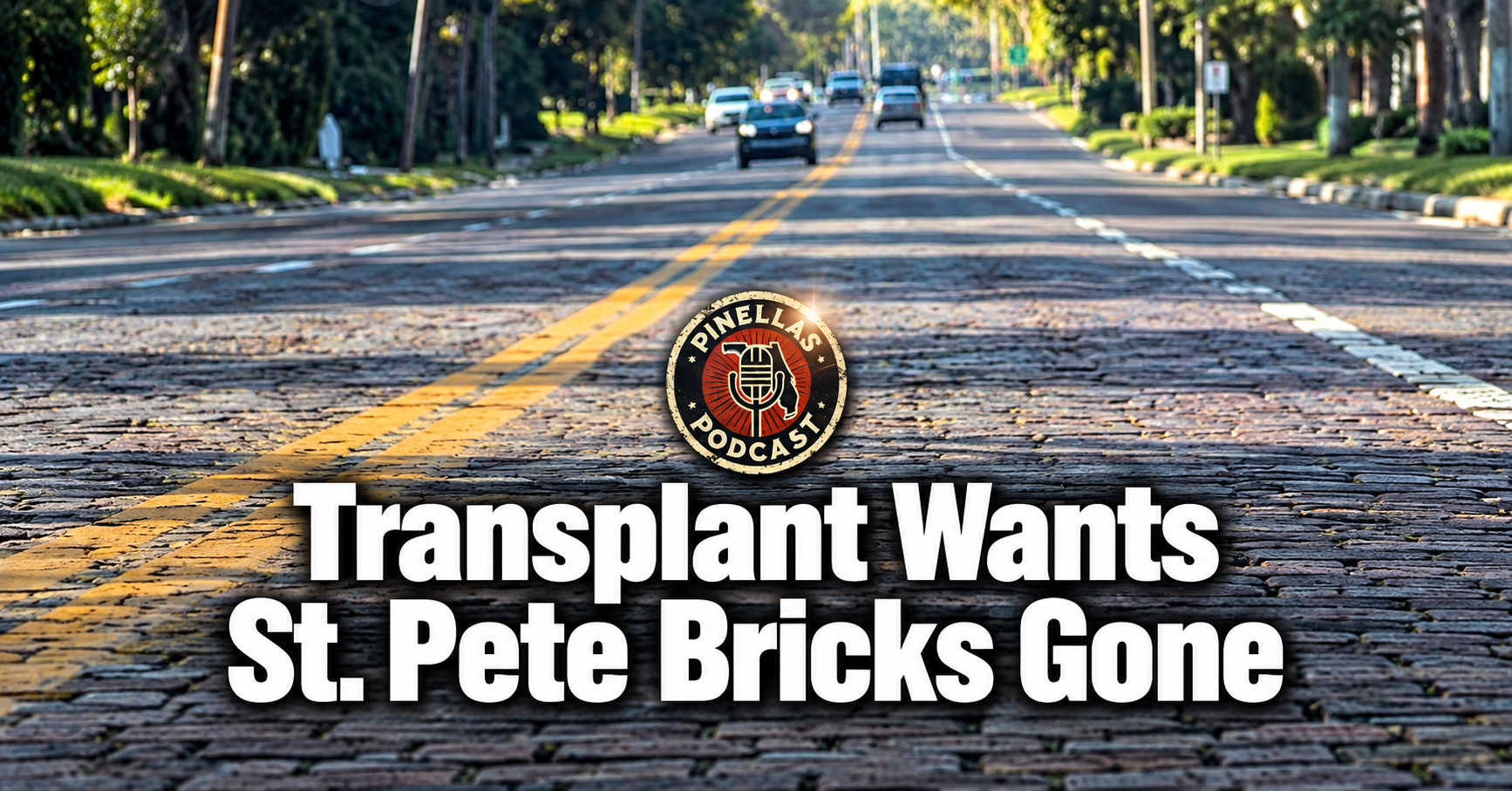
Transplant Wants to Cancel St. Pete Brick Streets?!
The Bricks Beneath St. Pete: Why Those Bumpy Roads Are More Than Just an Old Street
The now famous transplant who wants St. Pete’s brick streets replaced with asphalt because he says they’re wreaking havoc on his tires and alignment has definitely gotten people talking.
But before we send him back to Connecticut 😂, it’s probably worth explaining exactly what he’s driving on.
Because those bumpy old bricks aren't just roads the city forgot to pave.
They're pieces of St. Petersburg history — and some have been carrying traffic for more than 120 years.
Before the Bricks, St. Pete Was a Little Rough
Go back to the early 1900s and driving around St. Pete was a very different experience.
Early roads were commonly made from dirt, marl and crushed shell. Historical accounts even document shell being taken from Native American shell middens in the area for early road material.
That might work when you're dealing with horses and a relatively small population.
Then St. Pete started growing.
In 1903, the city began moving toward brick paving, and by 1904, brick streets were being installed.
And St. Pete didn't exactly dabble in the idea.
It went BIG.
Millions and Millions of Bricks
As St. Petersburg grew, so did its brick-road network.
Between 1909 and 1913 alone, $202,000 was allocated for street improvements and expansion of brick paving.
Then came the Florida land boom.
By 1928, St. Petersburg had 213 miles of vitrified brick streets.
By the early 1930s, historical reports put the city's paved-road network at more than 300 miles, and by 1941, St. Pete had an incredible 339 miles of brick streets.
Here's an even crazier number:
A 1922 account referenced 40 MILLION bricks bearing the word “AUGUSTA” already incorporated into St. Petersburg streets.
Forty. Million. Bricks.
And that brings us to the name you've probably driven over a thousand times without noticing.
What's an “AUGUSTA BLOCK”?
Next time you're walking along one of St. Pete's old brick streets, look down.
There's a very good chance you'll find:
AUGUSTA BLOCK
stamped into the bricks.
No, Augusta Block wasn't some legendary St. Pete developer.
The name points to Augusta, Georgia, where the Georgia Vitrified Brick and Clay Company manufactured the famous paving blocks.
These weren't the same kind of bricks you'd use to build a house.
The company used shale and clay and fired the bricks at extremely high temperatures, partially vitrifying the material. The result was an exceptionally tough paving brick designed to handle the abuse of an actual roadway.
Then those bricks had to get to Florida.
They traveled by train from Georgia to St. Petersburg on the Atlantic Coast Railway.
And that's where the real work began.
Yep, They Put These Things Down BY HAND
Imagine building a street without an asphalt truck cruising along behind you.
Crews first graded the road and compacted and leveled a sand or shell base.
Then workers laid the bricks by hand.
Individual brick.
After individual brick.
After individual brick.
Historical research shows the finished surface was then tested with a five-ton roller. If a brick broke, it was removed and replaced.
So the next time your car goes bump-bump-bump-bump through an old St. Pete neighborhood, remember:
Somebody actually put those things there one at a time.
More than a century ago.
And Some Still Have Fingerprints
This might be our favorite part.
Local historical research says fingerprints can still be found on some of St. Pete's old paving bricks, remnants of the manufacturing process from more than a century ago.
That's about as close as a street gets to becoming a historical artifact.
There is also a harder piece of history surrounding the industry. Convict labor was used in Georgia brick manufacturing and Florida road construction during the early 1900s.
However, surviving records are scarce about the workers at the Georgia Vitrified Brick and Clay Company and the crews who built St. Petersburg's roads, so we can't say specifically that convict labor produced or installed St. Pete's Augusta Blocks.
It's an important distinction.
We simply don't know enough about many of the people whose labor created these streets.
Augusta Block Wasn't the Only Brick in Town
Here's another fun thing to look for.
Although Augusta Block became the name most associated with St. Pete's brick streets, it wasn't the only paving brick used here.
You can occasionally find other historic manufacturers represented around the city, including Rockmart bricks.
So walking an old brick street can almost become a scavenger hunt.
But Augusta Block became so closely associated with St. Petersburg that the company actually used the city as a showcase for its product.
Imagine that marketing campaign today:
COME TO FLORIDA. EXPERIENCE OUR ROADS.
Apparently, 100 years later, they're still generating reviews. 😂
Then Asphalt Showed Up
Eventually economics won.
Asphalt and concrete became cheaper and more efficient ways of building and maintaining roads.
Brick construction declined.
But here's where things get interesting:
Some of St. Pete's old brick streets weren't removed.
They were simply paved over with asphalt.
That's one reason the visible brick network shrank so dramatically.
By 1960, only about 113 miles of brick roads remained.
Which means there are places around St. Pete where a perfectly ordinary-looking asphalt road may have a much older road sitting underneath it.
Then St. Pete Decided: We're Keeping These
By the early 1990s, attitudes had changed.
Instead of viewing the remaining bricks simply as outdated pavement, St. Petersburg increasingly viewed them as part of the city's historic character.
In 1992, the city adopted preservation policies protecting its remaining historic brick streets and alleys and granite curbs from additional paving and removal.
At the time, roughly 93 miles of brick streets remained.
Those protections were strengthened in later years.
And this isn't just some forgotten resolution sitting in a filing cabinet.
The City of St. Petersburg still maintains brick streets as an official historic streetscape material in its current historic-preservation mapping.
Recent historical research describes approximately 92 miles of brick roads and alleys as protected today. Other published totals have differed depending on whether the count includes alleys, so we're not going to pretend there's one magic mileage number.
The important part is pretty simple:
St. Pete once had hundreds of miles of brick streets. A much smaller surviving network is now treated as something worth preserving.
And Yes...They're Bumpy
Nobody is arguing that point.
More than a century of traffic, shifting foundations and expanding tree roots aren't exactly a recipe for freshly poured interstate pavement.
But there's a reason people love them.
They slow traffic.
Their sand-based construction can reduce runoff compared with completely impervious pavement.
And maybe most importantly...
They look like St. Pete.
Brick streets, old granite curbs and those distinctive hexagonal sidewalks are part of the visual character of the city's oldest neighborhoods.
In fact, St. Pete's hexagonal sidewalk blocks have their own long history, dating back more than a century.
The city considers both the brick streets and hexagon-block sidewalks part of its historic streetscape.
So...About Our Connecticut Friend
Is he wrong that St. Pete's bricks can deliver a rough ride?
Absolutely not.
They're bumpy.
But they're bumpy for a pretty remarkable reason.
When you're driving through an old St. Pete neighborhood, you may be rolling across paving blocks manufactured in Georgia, loaded onto trains, hauled hundreds of miles south and then placed into a Florida street by hand more than 100 years ago.
Those streets survived the Florida land boom.
They survived the bust.
They survived the arrival of asphalt.
They survived generations of development and hundreds of thousands of cars.
And a surprising amount of that brick is still underneath our tires today.
So yes, we could make some of these roads smoother.
But here's the question that has apparently awakened every longtime St. Pete resident on Facebook:
Do you pave over the bumps...or protect the history? 👇
Comments
Want to join the conversation?
Sign in to comment